James W. Miller Learning Resources Center (2000)
The James W. Miller Learning Resources Center continues a long tradition of housing St. Cloud State’s library. Since the Third State Normal School opened in 1869, the library has been in six buildings (including three built specifically to house the library), Miller Center being the latest.
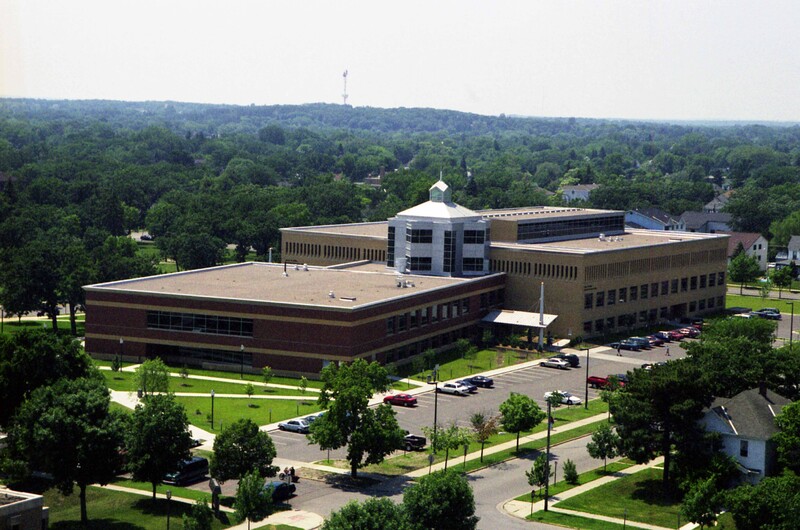
Miller Center, June 2001
Need
Centennial Hall, opened in the spring of 1971, was quickly outgrown by the increasing campus student population. By fall 1990, enrollment increased by 7,000 since 1971. Though Centennial Hall was built to accommodate an additional two stories, the library’s footprint stayed the same. By the late 1980s, serious consideration was being made to build a new campus library. In 1990, a “Library of the Future” study was conducted, and it supported the need for a new campus library.
Funding
Lobbying for a new library building soon began at the state level. In 1992, St. Cloud State was awarded $290,000 to develop “schematic plans to construct a new library” and the architectural firm Leonard Parker Associates was hired. The 1994 state legislature awarded $8 million to prepare working drawings for a new library. In 1996, state legislature awarded St. Cloud State $29.5 million to “construct, furnish, and equip a new library.”
Construction Begins and Groundbreaking
In the summer of 1998, Donlar Construction was hired to build the new library with a low bid of $19.88 million. This low bid allowed the addition of features that were previously cut, including the construction of a basement under Miller Center’s east wing.
The groundbreaking took place on September 2, 1998 and attended by Minnesota governor Arne Carlson. The library was to be built on a two square block campus parking lot, opened in late 1973, north of Barden Park that bordered by 5th Avenue South to the west, 6th Street South to the north, 3rd Avenue South to the east, and 7th Street South to the south. Construction began soon after the groundbreaking.

Arne Carlson at the Miller Center groundbreaking, September 1998
Pioneer Cemetery Discovery
On January 20, 1999, construction workers digging the new foundation discovered unmarked graves on the eastern side of the site. Work was briefly delayed and then continued elsewhere on the site. St. Cloud State archaeologists as well as from the state investigated. More graves were uncovered as construction continued. Faculty member Richard Rothaus headed the archaeological dig and led a team of students to remove and then study the human remains and material that were left behind. Most of the archaeological work wrapped up the next month and was complete by late spring.
A forgotten pioneer cemetery that opened in the late 1850s was discovered. It opened shortly after the city was established and used until the mid-1860s. With the opening of the city’s North Star Cemetery in 1864, bodies were exhumed and reinterned at North Star - yet some were left behind. Ultimately, 21 grave shafts were excavated, containing remains of 11 people – see the final archaeological report. An exterior plaque laid in a small boulder stands at the building’s southeast corner to mark and honor St. Cloud’s pioneer families. A similar marker lies in North Star Cemetery marking the spot where the human remains were reinterned.
Construction Continues
In January 2000, the new building was given a name – the James W. Miller Learning Resources Center. James W. Miller, who owned Miller Construction, had recently donated $3 million to St. Cloud State for scholarships and technology. Thus the building was named in his honor.

Pioneer cemetery archaeological dig, February 1999
Miller Center Opens
In August 2000, the Miller Center opened as home to Learning Resources and Technology Services (LR&TS). Costing $32.5 million to construct and equip, the building contained 235,000 square feet of space to house library resources, provided office space for library and technology employees, and home for students to research, study, socialize, and learn. There were 16 study rooms, 438 public computers, 1050 Ethernet computer connections, six classrooms, and 2,400 study seats, as well as a 182-seat auditorium and a large second-floor reading court. The reading court is 42 feet high from floor to ceiling. Technology provided the latest access to electronic resources while making available 567,414 monographs on mostly compact shelving. Also included was a coffee shop, 24-hour computer lab, and a climate controlled space for University Archives.
Other offices located in Miller Center included the Center for Excellence in Teaching and Learning and the Center for Holocaust and Genocide Education.
Dedication
On October 21, 2000, Miller Center was dedicated. Speaking at the dedication was renowned American science fiction author Ray Bradbury.

Author Ray Bradbury at the Miller Center dedication, October 2000
Changes in the Building
Since opening in 2000, Miller Center has had some renovation. In 2013, the technology help desk, computer store and lab support was centralized in the former 24-hour computer lab in the Miller Center first floor lobby. In 2025, they moved to the second floor. A specific library renovation included the move of Collections from the second floor to the first, adding office space added to the first floor west, and moves of the library dean’s office. Other changes in subsequent years include other offices moving into the building, including PACE, Graduate Studies and Sponsored Programs, and the campus food shelf.
In September 2005, a celebration marked the building's five years, honoring previous St. Cloud State LR&TS/Library deans, including Luther Brown and John Berling.
Architecture and Art
Miller Center is described as “post-modern,” which combines historical styles and modern materials. The use of yellow and red brick harked to the region’s early brick manufacturing. Many historic St. Cloud State buildings and neighboring homes were built with local yellow brick, and wealthier citizens often used red brick.
The central Lantern Tower stands 77 feet from the ground floor. The tower symbolized the light of learning, such as a lighthouse. The north and south entrances with their mast like canopies created the illusion of ships passing beneath the lighthouse above.
The tower is home to artwork entitled Opening Change by Kenneth F. von Roenn, Jr. Seen from the second and third level of Miller Center, Opening Change consists of dichroic glass and stainless-steel cables with forms that are suggestive of the opened pages of a book.

James W. Miller, January 2000
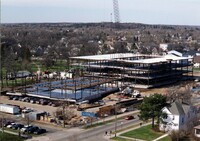
Construction, 1998-2000
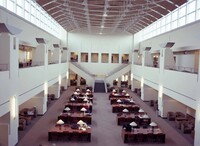
Reading court, April 2001
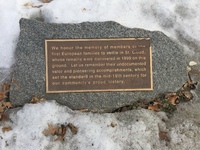
Pioneer plaque
Additional sources:
- Planning for the Future: An Overview of Building Goals for Learning Resources Services, 1991
- Walls Dissolve: Transforming Access to Knowledge: A St. Cloud State University Vision for the Library and Learning Resources Services Facility of the 21st Century. A Program Statement, September 1993
- Library for a New Century brochure, 1994?
- Press release, July 20, 1995 - Funding to be sought in upcoming Minnesota state legislative session for funds to construct library
- Library for a New Century video, 1998? - Video shows where building is to be placed, 3-D model, and a computer generated tour of the exterior of the building
- Press release, September 2, 1998 - Groundbreaking
- Press releases, January and February 1999 - Discovery of pioneer cemetery at the Miller Center site
- Press release, January 20, 2000 - Naming of building in honor of James W. Miller
- Press release, August 24, 2000 - Dedication ceremony details
- Dedication poster feature author Ray Bradbury, October 2000
- Self-guided tour brochure, October 2000
- St. Cloud Times newspaper article, August 21, 2010, by Bill Morgan - Miller Center architecture analysis