Stewart Hall (1948)
Nearly 75 years old, St. Cloud State was looking towards the future as the school continued its slow growth before World War II. The Old Main building, which opened in 1874 and included north and south wings constructed during the 1890s, showed its age. The 1930s brought the Great Depression. The result was the state of Minnesota not investing as much as what was needed for capital improvements at all state colleges. At St. Cloud State, a new main administrative and classroom building was needed.
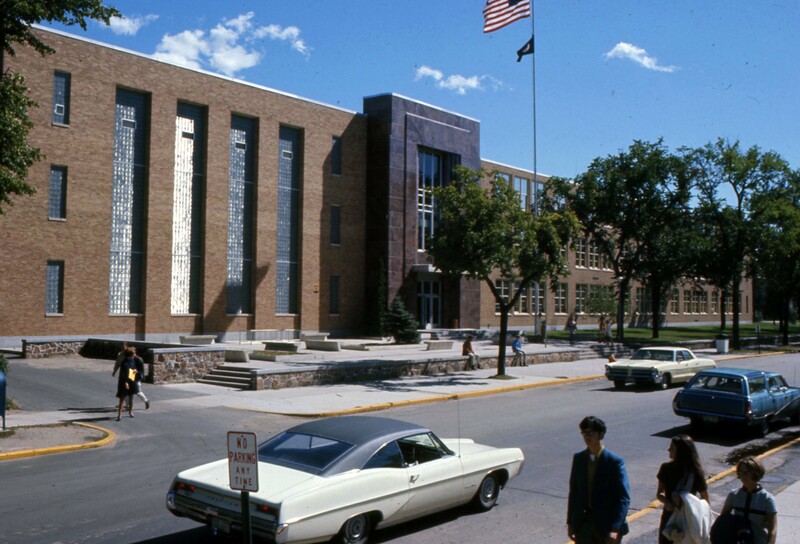
Stewart Hall, 1960s
Need
Compared to now, the 1941 St. Cloud State campus was small. It comprised of Lawrence Hall, Old Main, Old Model School, Riverview, Eastman Hall, and Shoemaker Hall. Though a few classes were held in Eastman Hall, Old Main contained all campus offices and provided nearly all instruction.
Administrators considered Old Main a fire trap. Speaking to the need of a new main building, St. Cloud State president George Selke said, “[t]he thing most immediately necessary is the substitution for the present main building of one where lives will not be in constant jeopardy from structural collapse or fire.” In the early 1940s, the student newspaper Chronicle urged students not to smoke in Old Main in fear of a possible fire.
On the cusp of World War II, the 1941 state legislative session appropriated $395,000 for a new campus main building. Requests for a new main building in 1937 and 1939 had been rejected by the state.
World War II Impact
The January 16, 1942 issue of the Chronicle reported that construction would be postponed for the duration of World War II. To be ready once the war ended, architects L.C. Pinault and Frank W. Jackson Associates finished the architectural plans.
With the end of World War II in 1945, life returned to normal. Thanks to the G.I. Bill, St. Cloud State had to be ready for the influx of veterans. The G.I. Bill gave returning veterans the opportunity to earn a college degree paid for by the federal government. Unfortunately, the 1941 appropriation no longer covered the cost of a new main building. Post-war saw increased construction material and labor costs. In the meantime, St. Cloud State adjusted by erecting temporary buildings and continued to use Old Main. To help get the new main building constructed, the 1945 state legislative session appropriated an additional $265,000, adding to the $395,000 already appropriated.
With the hope of a 1946 construction start date, the project went out for bid. Unfortunately, bids far exceeded the appropriated funds. In response, the 1947 state legislative session appropriated an additional $1.1 million for Minnesota state college buildings and specifically mentioned St. Cloud State’s new main building. Finally, St. Cloud State had enough funds in hand to build its new main building that included an auditorium.
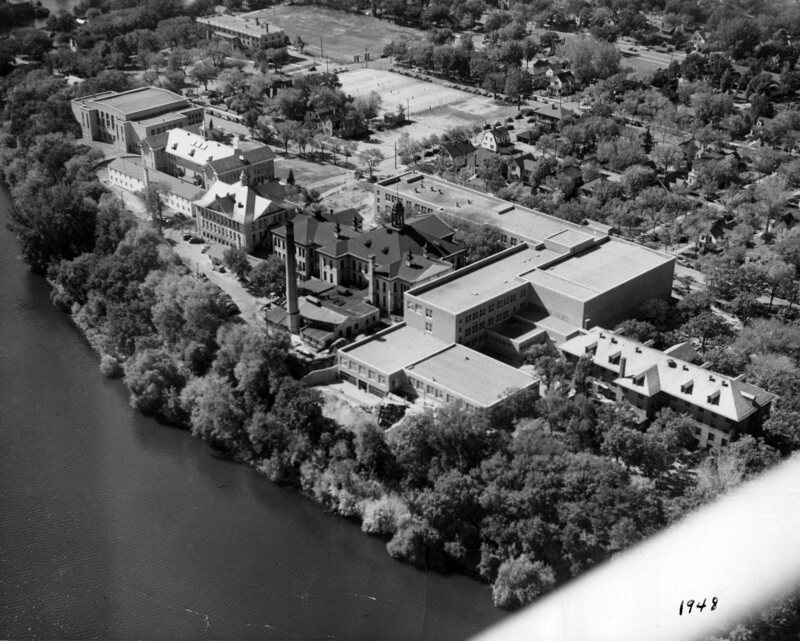
St. Cloud State campus, 1948
Construction and Opening
With revised architectural plans completed, construction began in the summer of 1947. The L-shaped new main building, which measured 320 feet by 348 feet with 270 rooms, was to face west and constructed around the Old Main building. Old Main’s north wing was torn down, and the rest of the building remained, allowing St. Cloud State to use the building as enrollment swelled. Being constructed by Hagstrom Construction Company, it was hoped it would be ready for the 1948 fall quarter.
Portions of Stewart Hall opened in October 1948. Construction continued until the building was finally completed in 1949. On December 3, 1948, classes were cancelled and students moved furniture and equipment from Old Main to Stewart Hall.
The 1949 Minnesota state legislature appropriated another $250,000 to help equip Stewart Hall.
Naming and Cornerstone
At the May 26, 1947, state college board meeting, the name Stewart Hall was approved for the new main building. It was named to honor Warren Stewart. A 1910 alum, Stewart served as St. Cloud State’s resident director on the Minnesota state college board from 1939 to 1948.
During construction, a cornerstone ceremony was held on May 4, 1948. Inside a 9-inch by 9-inch lead lined copper box, items were placed inside - 1944 college history, two copies of the Chronicle student newspaper, and 1947/48 and summer 1948 course catalogs. Also included was a May 1948 letter written by Warren Stewart and two lists with signatures of 47 St. Cloud State faculty members and 994 students from the 1948 spring quarter.
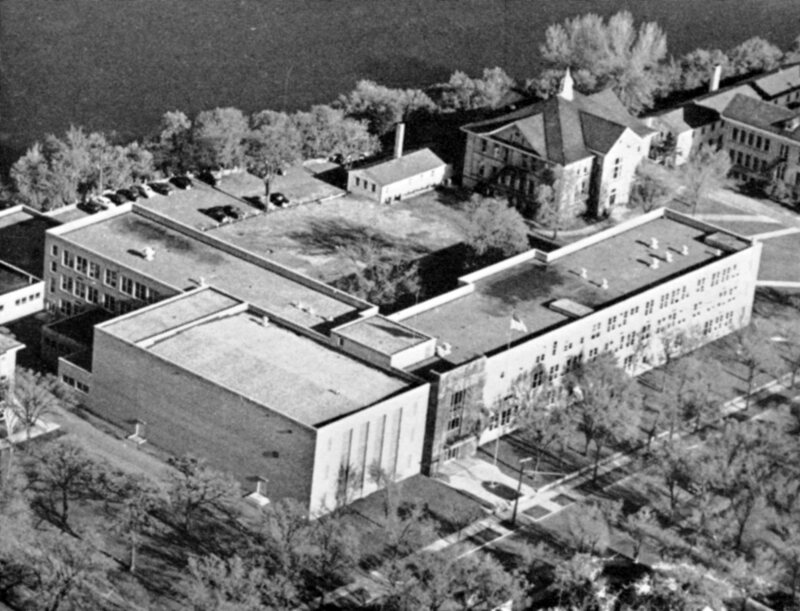
Stewart Hall, 1954
Renovations
With the arrival of the Baby Boomer generation in the late 1950s to college campuses all over the country, academics and physical campuses rapidly grew. Functions and academics moved out of Stewart Hall into new buildings as the St. Cloud State campus grew west of 1st Avenue South.
The 1976 state legislature appropriated $275,000 to renovate the Stewart Hall auditorium. The renovation, designed by architects Val Michelson and Associates, began in January 1977 and lasted a year. The purpose of the renovation was to “open ceiling and stage areas to give the auditorium a ‘one space’ look.” The renovation also made the auditorium “more acoustically functional” for musical events and to better accommodate a variety of programs. In 1995, St. Cloud State raised $650,000 to further renovate the auditorium again. Jan Ritsche donated $300,000 toward the campaign and resulted in the renaming of the auditorium to honor her daughter and 1982 St. Cloud State graduate Kim Ritsche. Kim died in a car accident in 1989. The renovation was done during the summer of 1995.
Many famous personalities have graced the building’s stage – author Arthur C. Clarke, singers John Denver and Reba McEntire, comedian Lily Tomlin, film director Frank Capra, actor Don Knotts, and Twin Cities rock group Trip Shakespeare.
From 1988 through 1989, Stewart Hall as a whole underwent a thorough interior and exterior renovation designed by architect Pauly and Olsen Associates – Traynor, Hermanson and Hahn. With an $8.1 million appropriation from the 1987 state legislature, Stewart Hall was renovated in stages by Donlar Construction. Phase I renovated the east wing, including a small building demolition and addition. Phase II renovated portions of the auditorium and its lobby and the south wing. The renovation corrected code violations, removed asbestos, upgraded mechanical systems, overhauled heating and cooling systems (including the addition of air-conditioning), and exterior renovation. The west face of Stewart Hall was completely removed and the main entrance enlarged. The auditorium entrance and its lobby were reconfigured, adding an additional entry point into the building.
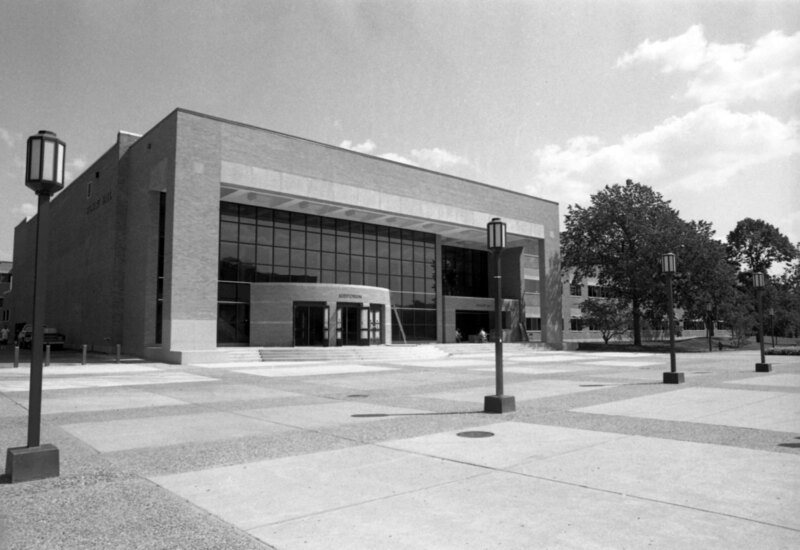
Stewart Hall after renovation, 1989
Rededication and Time Capsule
Coinciding with the 1989 homecoming celebration, the newly renovated Stewart Hall was rededicated on November 3, 1989. Mary Stewart Beckman, daughter of Warren Stewart, attended the festivities. Warren Stewart passed away in 1959.
The 1948 time capsule was still missing after the 1988-1989 renovation. Despite knowing the general area where the time capsule was located, it still was not found. In September 1992, the stone from the exterior was being crushed by a local St. Cloud company. Workers noticed a small metal object on a conveyer belt carrying crushed stone and stopped the machinery to investigate. The box was the time capsule. The company returned the time capsule to St. Cloud State in the fall of 1992 and subsequently placed in University Archives.
Today, the building is home to many academic departments, KVSC, UTVS, and other campus units.
The blueprints for Stewart Hall, as completed in 1948, are available on the University Archives’ Search portal.

Architect's drawing, 1944
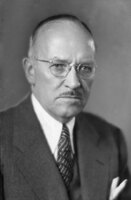
Warren Stewart, 1940s

Cornerstone ceremony, May 8, 1948
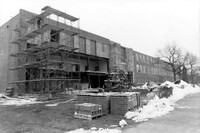
Exterior renovation, 1988-1989
Additional sources:
- Chronicle, January 24, 1941
- Chronicle, June 27, 1947
- Chronicle, October 8, 1948
- Stewart Hall floor plans, ca. 1948
- Dedication program, March 1950